Kleines Nesthorn above Blatten, Lötschental
Pre-failure permafrost evolution:
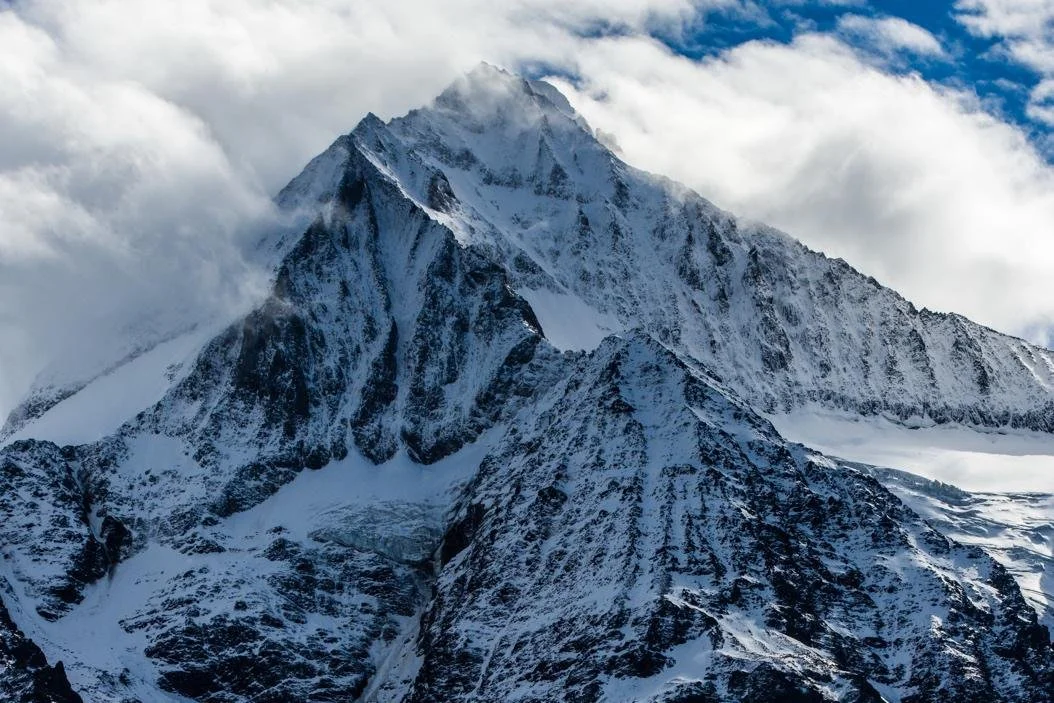
Foto Marco Volken, October 2024
As the atmosphere warms, mountain regions warm as well. Permafrost in cold mountains is highly sensitive to such temperature changes. Under frozen conditions, rock strength and slope stability are particularly high. However, rising temperatures cause frozen mountains to lose this additional strength. As ice disappears from cracks, fissures and micropores in the rock, water can infiltrate, enhance heat transfer, and further reduce slope stability.
Permafrost warming at depth occurs through heat diffusion and is often significantly slowed by latent heat exchange associated with local ice melt. This extremely slow combination of processes creates pronounced and long-lasting delays in the thermal disturbance at depth. In contrast to glaciers, which may disappear within decades to a century or two, complete permafrost thawing can take centuries to millennia. Permafrost in cold mountains will therefore continue to exist – although increasingly disturbed - long after glaciers have vanished.
The catastrophic destruction of the village of Blatten in the Valais Alps, Switzerland, by a large rock-ice avalanche on 28 May 2025 was initiated by the destabilization of the permafrost slope at Kleines Nesthorn. A combined thermo-mechanical 2D model calculation for the detachment zone prior to failure indicates an asymmetric permafrost distribution within the ridge, with a warm and a cold side. On the cold, destabilised slope, permafrost extended to depths of more than 200 metres below the surface. Since the Little Ice Age, warming and the associated reduction in stability have penetrated to depths of approximately 50 - 100 metres, hence affecting large masses of frozen rock.
At Kleines Nesthorn, permafrost warming and the related mechanical weakening over centuries, decades and years most likely acted as the final trigger for the collapse of a rock mass that had reached sub-critical topographic and geological stability conditions over much longer time scales. Similar developments are likely to occur in many parts of the Alps and in cold mountain regions around the world.
My own publications:
Haeberli, W., Cohen, D. and Arenson, L.U. (2025): On deep thermally induced stability changes in perennially frozen detachment zones of rock-ice avalanches: The 2025 Blatten event. International Mountain Conference Innsbruck 2025. https://imc2025.info/imc25/sessions-n-workshops/workshop/ws-3-133-the-avalanche-disaster-in-blatten/ Recorded presentation: (PDF)
Haeberli, W., Cohen, D., and Arenson, L. U. (2026): On transient thermally induced stability changes in high-mountain permafrost rock walls: A semiquantitative modeling approach applied to recent landslides at Rasac (Cordillera Huayhuash, Peru, 2023) and Blatten (Swiss Alps, 2025). The Cryosphere Discussion, EGUsphere [preprint], https://doi.org/10.5194/egusphere-2026-2821, 2026.