The Gruben Example
Cold Mountain Systems:
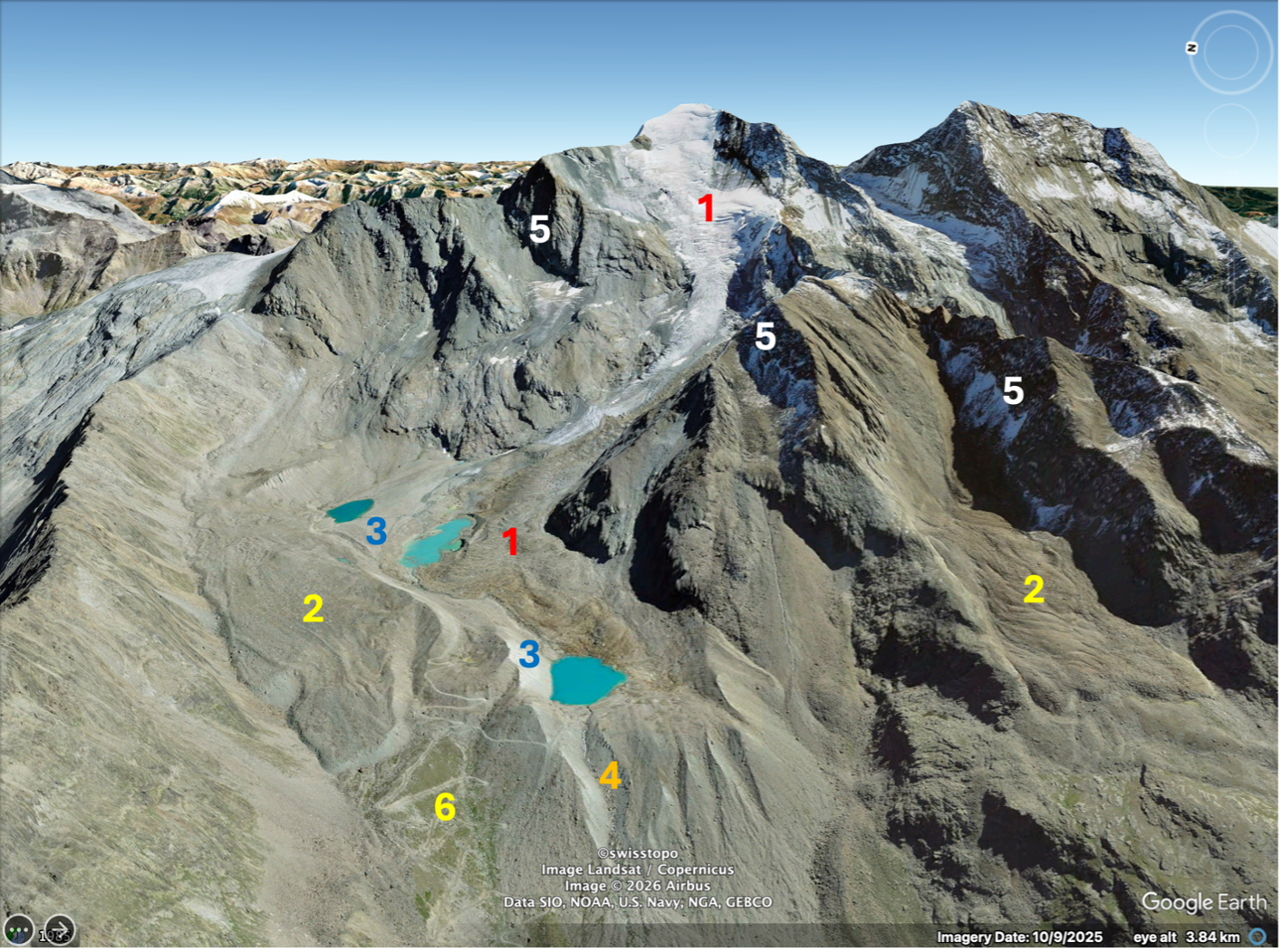
Complex, interconnected, and climate-sensitive cold-mountain systems have been studied in detail at the Gruben site in the Saas Valley of the Valais Alps, Switzerland. The Google Earth image shows the peaks of Fletschhorn (upper centre, 3,985 m a.s.l.) and Lagginhorn (upper right, 4,010 m a.s.l.) together with the rapidly retreating Gruben Glacier (1).
Large masses of debris are permanently frozen (permafrost) and have been undergoing slow, viscous creep for millennia, forming characteristic lava-like landforms known as rock glaciers (2). As a result of global warming, a system of lakes (3) has developed in areas formerly occupied by the Gruben Glacier. Outbursts from these lakes in 1968 and 1970 eroded a deep breach (4) into moraine deposits formed during earlier, colder periods when the glacier extended farther down the valley.
These outbursts triggered large debris flows, that caused severe damage in the main valley. The surrounding rock walls, particularly on the shadow side of the mountains, remain frozen to great depth (5). Warming and thawing of this rock permafrost reduce slope stability, leading to increased rockfalls and rock-ice avalanches. The tongue of Gruben Glacier is heavily covered by debris from such recent rockfall events.
A comprehensive understanding of the climate-driven evolution of this interconnected system requires detailed analysis. Such knowledge forms the basis for effective hazard assessment and the successful implementation of protective measures, including the safeguarding of critical infrastructure such as the access road used for construction work (6).
My own publications:
Haeberli, W., Kääb, A., Vonder Mühll, D. and Teysseire, Ph. (2001): Prevention of outburst floods from periglacial lakes at Grubengletscher, Valais, Swiss Alps. Journal of Glaciology, 47/156, 111-122.
Gärtner-Roer, I., Brunner, N., Delaloye, R., Haeberli, W., Kääb, A. and Thee, P. (2022): Glacier-permafrost relations in a high-mountain environment: 5 decades of kinematic monitoring at the Gruben site, Swiss Alps. The Cryosphere 16, 2083-2101. doi.org/10.5194//tc-16-2083-2022
Haeberli, W., Arenson, L.U., Wee, J., Hauck, C. and Moelg, N. (2024): Discriminating viscous creep features (rock glaciers) in mountain permafrost from debris-covered glaciers – a commented test at the Gruben and Yerba Loca sites, Swiss Alps and Chilean Andes. Invited Perspective, The Cryosphere 18, 1669-1683. doi.org/10.5194/tc-18-1669-2024
Wee, J., Vivero, S., Mathys, T., Mollaret, C., Hauck, C., Lambiel, c., Beutel, J. and Haeberli, W. (2024): Characterizing ground ice content and origin to better understand the seasonal surface dynamics of the Gruben rock glacier and the adjacent Gruben debris-covered glacier (southern Swiss Alps). The Cryosphere, 18, 5939–5963. https://doi.org/10.5194/tc-18-5939-2024